During 2019 and 2020 I became more interested in environmental projects, and remain so. This page will serve as a collection of links of useful material (and archive backup as things go offline).
Links
https://online.retrosuburbia.com/
Environmentally-friendly KANDI (2023)
KANDI refers to plastic bead bracelets, and other plastic adornments, typically handed out at electronic music festivals, as a symbol of PLUR (peace, love, unity, respect). More information can be found here. However, KANDI is typically plastic, so I will be investigating whether it’s possible to create a form of KANDI that is not only environmentally-friendly, but can be used as emergency fuel for heat and/or fire starting.
Spotted Lanternfly (2023)
This is an ongoing project to identify methods of control for the spotted lanternfly infestation of the Northeast. The original idea was to find local Trees of Heaven using NYC’s Tree Map, then wrap the trunks with sticky tape to prevent nymphs from climbing up. However, local tree observation has indicated that nymphs prefer younger saplings, perhaps because they have more vigor to feed upon. Saplings emerge very readily, so one approach may be to use a glyphosate solution injected into the tree bark to kill the saplings.
Further observation has demonstrated that Tree of Heaven sprouts readily in disturbed and “interstitial” spaces (like highway medians), and is widely distributed across the New York City metro area. Most of them have nymphs. Glyphosate injections may be the only choice.
Paulownia Planting (2022-2023)
This is a moribund project to fill daikon radishes with a mixture of soil, fertilizer, and seeds of a non-invasive variety of Paulownia, obtained from the World Paulownia Institute, then toss them into abandoned lots in NYC. Unfortunately I realized that outside of a few spaces by the river somewhere, most lots in NYC are already managed by a local group. Additionally, I did not want to step unwittingly into the role of “non-local white man comes in and fucks things up”. It was also difficult to test daikon crack strength in the park somewhere.
Community Garden (2020-2022)
During the pandemic, I joined a local community garden. I was assigned a 25 by 4 foot raised bed and set about converting it into my paradise while learning a lot about growing in the ground. This is very different from containers, considering the bugs, planting methods, and coordination that has to be done just to keep track of what is growing and how well. I had read a lot about permaculture and practiced keeping the soil covered with leaves.
Eventually I also revitalized the compost collection process and headed the compost committee for a year, until leaving for NYC. This allowed me to join the garden board and participate in meetings. I eventually gave a talk about lessons learned about building community, at Toorcamp 2022.
Lawn rewilding (2020)
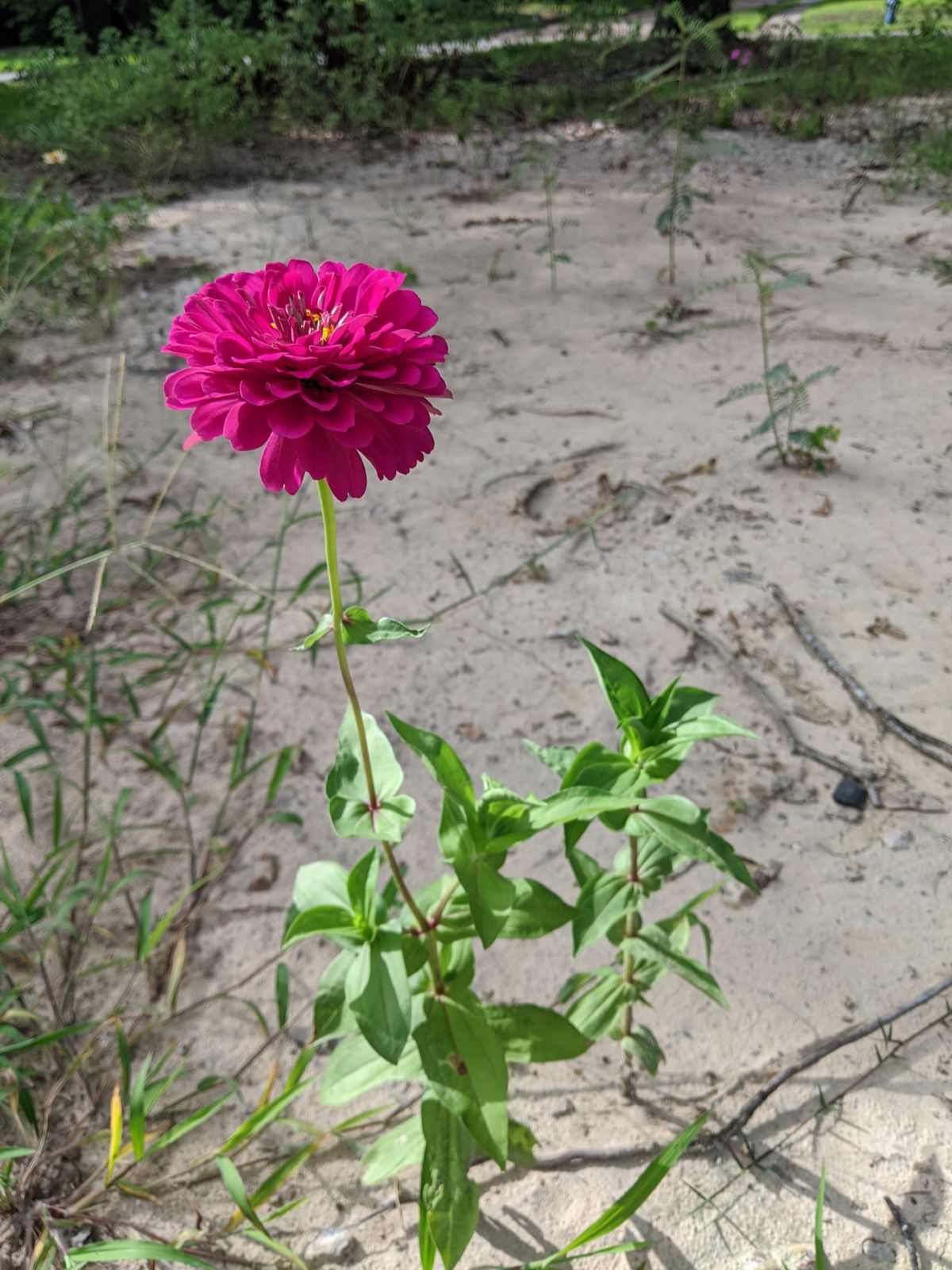
At the start of the pandemic, I sowed ten pounds of wild clover and wildflowers across twelve empty lots of houses that had been knocked down after the repeated Houston floods of 2015, 2016, and 2017. The seeds and flowers had been selected for drought tolerance and ability to grow in the sand that was typically put down after the demolition was complete. I quickly learned that nothing would grow because, despite there being essentially no reason for it, all these lots were mowed regularly. Just one lot was not and a few Zinnias were able to flower. In retrospect, a much more intelligent choice would have been to put down a lot of fertilizer to replenish the nutrient-starved soil and let nature do its thing.
The second phase of the rewilding was to order and plant several seedlings of a non-invasive variety of the Royal Empress Tree, aka Paulownia, in the corners of three lots. This tree is one of a few flora that uses C4 photosynthesis, enabling it to grow very quickly. Under optimal conditions this tree can grow sixteen feet in its first season and then four feet or more each year thereafter. It can also be used for pollarding which could come in handy in the future. However, I soon learned that Houston is not optimal. Despite preparing the planting holes with compost, leaves, and nitrogen fertilizer to counter the nutrient drawdown that would be caused by the leaves breaking down, the seedlings struggled in the hard-packed clay “gumbo” that characterizes Houston’s soil. It was probably also too humid and hot.