Rocket Tests and Videos
January 2014:
Found the lovely idea of sugar rockets, found a recipe from Dan Pollino’s website calling for potassium nitrate, sugar, and corn syrup, mixed up a batch in 3/4″ PVC, and watched it make a lot of smoke.
It was time to get Serious.
February:
I started out using Stump Remover, which was basically just Potassium Nitrate, sugar, and water, in a dissolving method but came out with crumly, wet grains, and abandoned that recipe.
The next attempt used James Yawn method, with corn syrup, in a skillet. It took several tries till I realized that the best results came from starting out on Med-Low, then switching to Low during the mashed-potato stage, and lowering even further, nearly to warm, during the evaporation stage. At this point the grain was usually tan-colored from caramelization. Test results were mediocre, with little thrust being produced and no pressure tests.
March:
Tried out Dan Pollino’s method. Here’s an example:
100 grams KNO3, 29.23 grams Karo Syrup, 23.1 grams Sugar.
Grind the sugar up and shake it with the potassium nitrate.
Put the Karo syrup in a skillet, then heat it until it reaches about 180 F.
At this point add the powdered mixture, and heat until the whole thing reaches about 210 F, at which point it’s time to cast.
My results were usually brown and could be poured. They also made impressive pressure tests in non-case-bonded PVC grains with PVC end caps.
At this point I switched to potassium nitrate purchased in a 10-lb bag from Ebay.
April:
By this time I’d mostly given up on KNO3/Sugar/Karo mixtures. I tried packing a finely-powdered mixture of sugar and potassium nitrate into a tube, but only managed to have it burn embarassingly for a minute or two.
In late April the first successful flight occurred, with a mixture of KN/Su/CS/water.
May:
Experimentation with core widths (1/4″ and 1/2″). Still using inhibited sleeves.
Multi-grain configuration tests, which failed. Improperly-capped PVC (no cement, cap just slammed in place) failed or blew up. Using the grain itself in an uncored simulation was not a good cap either.
June – No experimenation.
July:
By this time I’d started ramming caps of Bentonite, a fine clay powder that when hammered becomes rock-hard. I’d also started using 1″ ID cardboard tubes, usually meant for fireworks. These are lightweight, cheap, and very strong. All the motors were end-burners. Some were too dry, some were too wet, some flew, most did not.
Had now switched entirely to 60/40 mix of KNSU/CS/H2O, still melted in a skillet.
For July 4th I attached a large shell to an E9-4 estes engine, which flew quite well.
August:
Built a thrust measuring system using a fish scale and finally measured the thrust my rockets were producing. One of the rockets produced about high C to low D amounts of power.
That thrust system was pretty bad, so a few weeks later I got a mechanical kitchen scale. The rockets are wired to the stand, upside down, then lit with fuse. Example
September:
Tried to grate solid material to pack into a rocket but only managed to blunt the grater. The test was odd. Performed many thrust tests, but continued to get inconsistent results. Lesson: don’t use skillets for this sort of thing, since the temperature of the mixture just keeps increasing without any real end.
Tried reusing used tubes+caps, which was a bad idea. All of those tubes’ caps failed.
October:
Finally got an electric skillet and watched this video showing how James Yawn mixes and melts his own stuff. This meant that my grains started coming out much more uniform, with no caramelization. A little bit of experimentation showed how much to dry out the grain for, to get rid of the water.
Started adding small amounts of Red Iron Oxide (RIO) to the grains, which noticeably improved burn uniformity and speed. 1% was good, but not enough.
November:
Recalculated the 60/40 mix to be 65/35, for more power. Also started adding 2% iron oxide to the rockets, which were still nozzle-less.
The rockets were finally flying out of sight, but it was obvious they were barely able to lift their own weight, let alone that of a 3-inch shell (5 oz). Despite having increased my tubes over time to have 6.5″ of cored grain, weighing 8 ounces at liftoff, and having as much as 10 grams of RIO per rocket, they still started out too slowly. So I bought some rockite, got a cone mold from Hobby Lobby, and made some nozzles. The first tests were extremely satisfactory. Throats less than 1/4″ width were too narrow, and I’ve settled on throats of ~3/8″ width.
December: Cast a few rockets that will be cored, with nozzles that have 3/8″ throats. This is the final batch of tests, to determine a) whether or not 3/8″ throats are too narrow for the pressure that will be generated, and b) are these grains sufficient to lift 5 oz at least 300 feet. To this end, there are three tubes, 5″, 6″, and 7″ long.
Update: Based on results, six-inch-long tubes are best. More than that becomes heavy. However, I still needed some lift tests, so made two lengths – one was 7″ cored, the other was six inches, uncored. The first had a cap failure, and the second (with a lime on top) was simply embarassing. I suspect that 3/8″ throats are too narrow, and perhaps something closer to 1/2″ is better. I will also be drilling holes in the cardboard around the cap to allow the rockite to have a hold inside the cardboard, and also top off the cap with PVC cement.
Based on these results I will need to use estes rockets to lift the firefly shells that are in the works now, as a backup to whatever I manage to cast before the new year.
A very belated update May 2015: A New Year’s resolution was to stop all the rocketry and fireworks. Primary reasons were because I lack the tooling needed to get reproducible results, such as a drill press; lack of an acceptable testing ground for fireworks and rockets; and no mentorship. There’s only so many times you can watch rockets explode or fly violently off course because you messed up a tiny little thing. I never did get to shoot off the rockets made for the New Year, and wound up trashing most of my supplies (tubes, powders, sticks, rocket kits, etc). I also quit video gaming for real this time. Oh well. I’ll get back to it again someday.
July 2015: Shot off several of the rockets. All of them had at least ~5% titanium inside, and some had piccolo petes glued to them, meant to ignite before lift-off. In all cases the effect, light-wise, of the titanium was negligible. Out of six rockets, only one did not lift off and popped on launch. Despite their age, all of the rockets behaved ok.
October 2015: Shot off one 12″ rocket, that was uncored but nozzled, without iron oxide. This one didn’t lift but instead burned for two minutes with ferocious amounts of smoke.
December 2015: Observation – Kept in a lidded container with several large dessication packets, four remaining rockets have remained just as good as the day they were cast. The corn syrup really does a great job of preventing moisture absorption, something I’ve read about elsewhere.
February 2016:
I still have a few rockets, so here are some pictures. The nozzle is made with  Rockite and a set of plastic cones used in cookie making. This is imprecise, since if the tube is even slightly slanted the rocket will rotate wildly. However, the performance is almost worth the rotation, so I stuck with it.
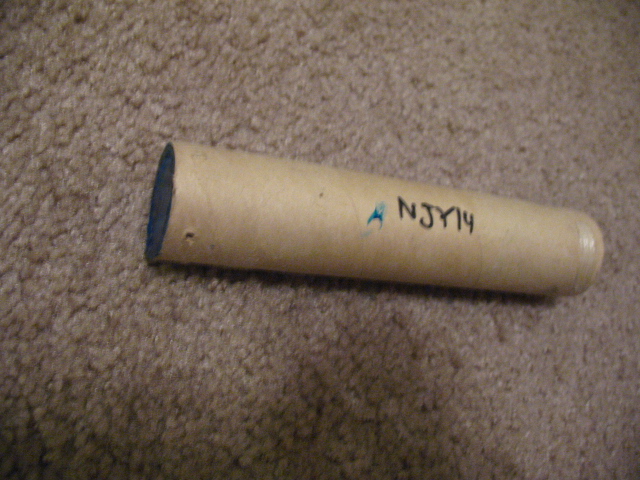 Here’s a picture of the final tube, six inches or so in length. This was what became my nozzled rocket standard. Nozzle-less rockets were roughly seven inches in length, because at one inch grain width, you can fit four 1.625-inch case-bonded BATES grains into this tube and still have space left for a concrete cap, made of 10 grams of compressed Bentonite.
The end has a cap that has been covered with blue PVC glue in hopes that it provides some more bonding strength.
Labeling tubes is useful since the tube can then be matched with a label written in a notebook when casting. This tube used my “new” fuel from a video by James Yawn mentioned above, which involved an electric skillet. Thus, it’s called NJY14 (14th made so far with this method).
All rockets by the end included red iron oxide, at two percent of the weight of the other ingredients (so really 1.5-2 percent of the total including the iron oxide). Nozzle-less rockets also included around five percent of spherical titanium (40-100 mesh). In actual flights this amount of titanium is obviously inadequate, however incorporating more than five percent makes for increasingly dry and pasty fuel.